

This article is about recalling a diagram very accurately by recalling drawing instructions from a peg (loci) system.
The basic idea is that, as you travel from peg location to peg location, you find an instruction to plot a point on a grid or draw a line from that point to another point; and then there are other ideas like 'how would your peg system tell you that an annotation should occur on the graph?'.
The grid probably will not be seen on the drawing you would make: the grid is typically intended to guide you in where to plot and draw on a page.
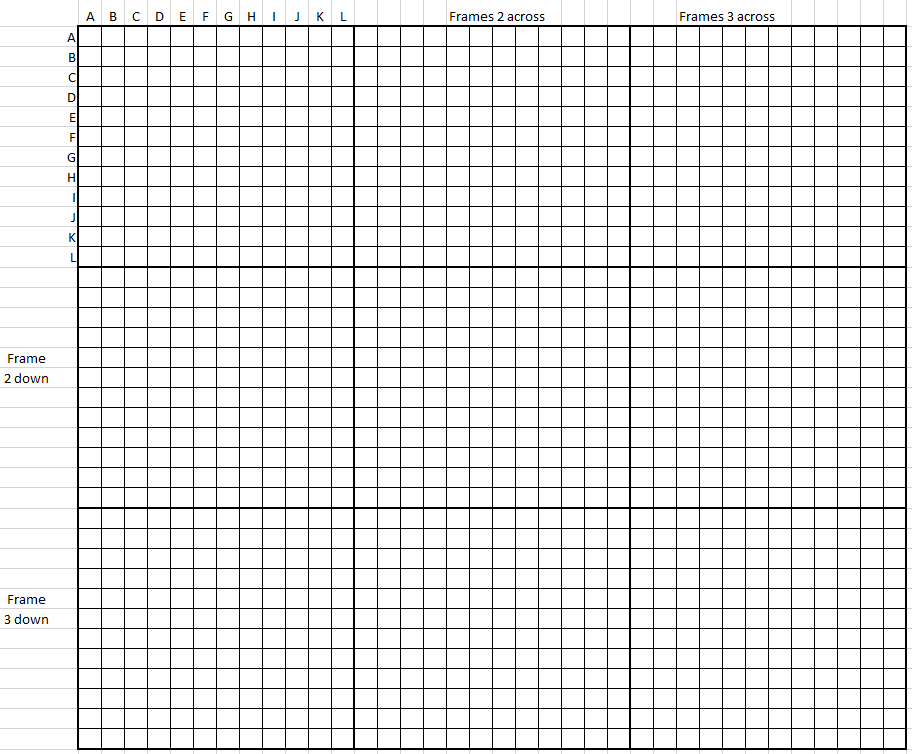
A 'frame' is a 12 by 12 set of squares (or cells)
State how many frames occur down (3) and how many frames occur across (3): 33
Use the AA-ZZ system to represent a plot point on one frame.
Eg. HF represents 'go down to H; and across to F; and plot that square.
State which frame to draw that plot point on by using the 00-99 people system.
So 2 frames down and 3 across sould use Person 23.
Know how many frames down and across the grid picture will be contained in:
Use an image from the 00-99 Double Digit Acrotics system as the first peg of the drawing.
Have a way to give the drawing a title:
Peg 1 of the list of pegs can be assumed to be a prompt for the title.
When those prompts are finished, the next peg will use the Double Digit Acrostics image to
define the size of the grid.
In order to represent one plot point, expect pegs to give you something like:
Person 23; and then the next peg to be AA-ZZ image HF.
That is quite costly because 2 pegs are needed to achieve that.
We want to express drawing actions without unnecessarily using a lot of peg locations
to do that.
The next peg is used to draw a line. The line might have a curve in it.
So there needs to be a way to state the destination cell on the grid; and
to state if the line drawn between the starting point and that destination point is actually a curve.
Often, the destination square is going to be near the square that the pen is currently on.
So use an AA-ZZ letter pair to represent a relative position on the grid:
With the first letter of the letter pair, it is describing an up or down position for that second square; and
the second letter of the letter pair states a left or right position for that destination square.
A to M means 'go up 1 to 13 squares'. N to Z means go down 0 to 12 squares'.
But, for the second letter of the letter pair, A to M means go left 1 to 13 squares; and
N to Z means go right 0 to 12 squares.
The next item stored at the next peg is information about whether to do a curve or a line; and
whether the line drawn is the finishing off of a shape; and whether the line borders another shape.
Options are:
1: A regular line that is not the end and is not bordering another shape;
2: A line that borders another shape.
3: A line that is the end of srawing a shape.
4: A line that is the end of drawing a shape and which borders another shape.
Whether the line is straight or curved can be represented by:
0: straight line
1: slight curve upwards or rightwards
2: slight curve downwards or leftwards
3: medium strength curve upwards or rightwards
4: medium strength curve downwards or leftwards
5: sharply bending curve upwards or rightwards
6: sharply bending curve downwards or leftwards
7: a wiggly line that drops and then rises and drops down to the destination cell.
8: a wiggly line that rises and then drops and then rises to the destination cell.
9: a dotted line
The 4 options above combined with thos 0-9 line shapes can be represented by numbers 10 to 49.
The Double Digit Acrostics images can be used to represent those numbers.
If the destination square is not so near then you need to use the original point plotting method:
state the frame and the position within the frame. Eg.
Person 12; and then the next peg to be AA-ZZ image CK.
After that would be an image for 10 to 49 since it is about what type of line or curve to draw.
If you arrive at a cell and want to annotate it then you want a line to be drawn away from it; and
you want text to be written at the end of that annotation line.
And the positioning of the wording might need to be:
1. Regular left to right to meet the line.
2. Word wrapped because otherwise the text will overlap something else.
3. Word wrapped but start writing above where the line ends so that the last word
4. Left to right but the writing begins where the line ends.
occurs where the line ends.
You can use the 0 to 9 cartoon images 1 to 3 to mark that an annotation line is about to happen; and where you
want the annotation text to be positioned.
The next line that is drawn is obviously the annotation line. Use AA-ZZ mnemonics to spell some or all of the annotation.
Eg. PL can prompt 'Palisade Layer'.
Maybe you do not want an annotation line but just an annotation:
5. Regular left to right to meet the line.
6. Word wrapped because otherwise the text will overlap something else.
7. Word wrapped but start writing above where the line ends so that the last word
That can be represented by 0-9 cartoon people 4, 5 and 6.
8 Left to right but the writing begins where the line ends.
Once the annotation is done, you either want to continue drawing from the point you left off at; or
you want to plot a fresh point; but since you have already noted if a recent line is the end of a shape or not, this can be deduced.
Other features you might want to represent are pen width change (one-off or new default);
that could include whether the pen goes into a dotted line mode or is a regular straight line mode.
Animal system A1 can mean pen width 1 (regular line); Animal system A2 can mean pen width 2 (regular line).
If this is just a one-off then use 1A and 2A from the animal system instead.
Animal system D1 can mean pen width 1 (dotted line); Animal system D2 can mean pen width 2 (dotted line).
If this is just a one-off then use 1D and 2D from the animal system instead.
At the end of drawing a shape, flood fill it with a colour (use the A-Z system since each letter has a colour from the Colours article). Or else memorise a plot point and immediately follow it with a flood fill instruction A-Z for a colour to fill whatever shape that plot point is inside of.
You could make other mnemonic images to mean other drawing instructions such as marking a big dot at a coordinate on the page: one or more pegs would state the position on the page; and the next mnemonic image would be an instruction to draw a big dot there.
Grid Border
Plotting a point in a small square of a 12 by 12 frame is one way to plot a point but it would not let me plot a point on the border of the frame itself.
So I decided to use the Woman 1000 images of 000 to 999 to allow me to draw a line to a border point; and the approach lets me plot some other positions too which the 12 by 12 approach does not reach:
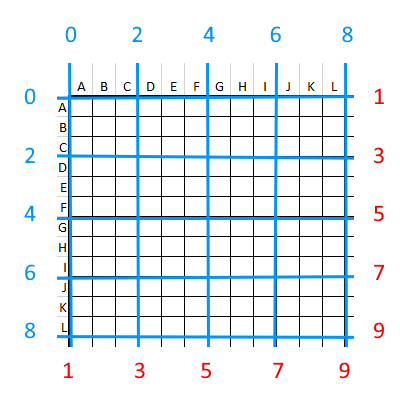
That frame is expressed as 5 plot positions across and 5 plot positions down. I can state a frame from 1 to 9: the currently positioned frame is always assumed to be frame 5:

And a number like 346 can mean "At Frame 3, plot at position 4 down and 6 across. Or 306 would be a plot point somewhere along the top border of that frame.
If the 'down' number is an even number then subtract 1 from it and assume that, rather than a line, a convex curved line is wanted. Eg. 258 would mean Frame 2, but not 5 down. Instead, do 5 minus 1 to get 4. So you are plotting at the position 4 and then at 8 across; but it is not a line from your current position to Frame 2 plot point (4, 8). Instead, it is a slightly curved line.
If the 'across' number is an even number then subtract 1 from it and assume that, rather than a line, a concave curved line is wanted. Eg. 281 would mean Frame 2, 8 down; but at the 0 across point becaue 1 minus 1 is 0. And a curve would happen rather than a line.
If both the down and the across numbers are odd numbers then subtract 1 from each of them and do a dotted line from where the pen is to that plot point.
This approach is good for touching a border but it is a more sketchy positioning because it has less places to plot at than the 12 by 12 approach does. However, a single mnemonic image from the Woman 1000 system is enough to not only plot a point but to know the line drawing nature of it as well.
For convenience, software could be written (or Excel with macros could be developed) so that you could easily plot and draw your diagram; and then the program would list to you all of the peg list items you need to memorise the diagram.
Another Drawing Method - Six grids of 6 by 6
The method above involves plotting points and drawing lines. In contrast, the method here is a bit like a printer producing a line across paper, then the printer scrolling the paper so that another line can be drawn; again and again: scroll and draw line; and, from a distance, the collection of lines resembles a picture.
Imagine a grid that is 6 squares across and 6 squares down; and any of its 36 squares can be a filled in black block:

I want there to be a way to express which squares of the big '6 by 6' grid need to be completely filled in.
Rather than be a white square or be a black square, I have two "filling in" methods for a square so that I can work on its 6 by 6 mini squares.
The first method is to use binary across any line of 6 mini squares so that, if the far right mini square is black then that is a 1, if the just the square to the left of it is black then that is a 2; and if both squares are black then that is a 3: 2+1 . I need 64 images to each represent any of the outcomes where a line of 6 mini squares can have black and white bits. That is the Binary method.
The other method is to assume that, if a square of the main 6 by 6 grid is leftwards then it can have each of its mini lines be expressed by a line that is going from right to left. So its value could be 0 length all the way up to 6 length. If, on the other hand, the square of the big grid is on the right side then similar lines can be expressed but they draw from left to right across the mini squares of a mini row. That is the Strips method; and I can use an image that represents 000 to 999 to indicate the lines to draw for three mini rows of a sqaure:
0: Draw no line across the mini row concerned.
1: Draw outwards 1 square of the small '6 by 6' square.
2: Draw outwards 2 squares of the small '6 by 6' square.
3: Draw outwards 3 squares of the small '6 by 6' square.
4: Draw outwards 4 squares of the small '6 by 6' square.
5: Draw outwards 5 squares of the small '6 by 6' square.
6: Draw outwards all 6 squares of the small '6 by 6' square.
7: Draw two filled in squares at the middle two of the 6 small squares.
8: Draw two filled in squares at furthest two of the 6 small squares.
9: Two black squares, a white gap of two squares, two black squares.
What if the aim is to use the big 6 by 6 grid to draw roughly a country outline? The drawing of a country is an approximation; otherwise, I would not be able to use a three digit number to express drawing rules: there would be too many detail options.
I want to give an overview of the filling in that is required for that country: a way to say that any of the main 36 squares (6 by 6) is white or black or uses a filling method (that I just described). So there are 3 choices. So images for all 3 x 3 choices of 3 squares would need 27 images as a pool to pick from. The first 3 squares from the top left and rightwards would use one image to express the choices of those three squares. There would be 12 peg loci used and an image from that 27 pool would be memorised at each peg. In that way, all 36 squares would be dealt with.
You could then use peg loci to provide the detail of any square that needs a special fill method. So if a square needs the Binary method to fill it then you would use a pool of 64 images to represent each horizontal mini row of the square concerned; and that image pool would be different fom the 000-999 image pool of the Strips method; in that way, an image implies which filling method is being used. If a big sqaure is all white or all black then you know that your filler loci scenes are not relevant to them.
As long as you have a rule about how you travel from left to right and then down when expressing which major squares are black / white / fill method then you can deduce which filler loci relate to which major square.
The Strips Method uses two images and two loci per major square. So, it is less effort to use that approach than the Binary method which uses 6 loci per major square.
Plotting Prose
If you can draw the rough outline of an area like the island of Ireland then you can imagine a grid of 5 down and 5 across:

You can use the spelling ranges of the Double Digit Acrostics (and 'Person 00-99') article to represent down and across positions on the 5 by 5 grid.
The acrostics article explains how two digits can be represented by a word where the first two letters are in a range such as the word "Well" to the end of the alphabet. In that system, "Well" to the end of the alphabet means digit pair 00. A word like "Wish" is between "Well" and the end of the alphabet; so prose with that word needs Wish interpreted as 00.
There are 25 squares in the 5 x 5 grid. Ignoring 00, acrostics for 01 to 25 can represent the 25 squares of that grid; and so can acrostic spelling ranges 26 to 50 or 51 to 75 or 76 to 99 [and use 00 for the final bottom right square].
Leinster is 3 down and 4 across on the grid map above. But, counting left-to-right at each row, it is square 14. So I can use acrostic 14 or 14+25 = 39 or 14+25+25 = 64 or 14+25+25+25 = 89 to represent square 14. 14 is acrostic spelling range "Century to Chime" [where Chime is the point at which 15 spelling range begins]. So a phrase like "Leinster is CHArming" is a way to store the square 14 information. Or you could say, "The Lion is charming" amd try to remember to think of Leinster as a sound-alike "lion". Or maybe you could picture a lion in that position on the 5 by 5 map of Ireland.
Double Digit Acrostics for plotting a country
In this map, I have grid squares that are 10 degrees by 10 degrees; and I have software that plots a typical country within the bounds of a 5 by 5 grid map. E.g. France:

Put simply, there are 4 types of square fill:
1. A square has no part of the country in it.
2. About a quarter or less of a square has part of the country in it.
3. About a half or less of a square has part of the country in it.
4. Most or all of a square has part of the country in it.
Double digit Acrostics represent digits 00 to 99 by us looking at the first two [sometimes three] letters of a word. Here is a way to use the acrostics spelling ranges to represent those 4 options or pairs of those options:
| Acrostic Digits | Square Fill Instruction |
| 00 | A square has no part of the country in it. |
| 01 | About a quarter or less of a square has part of the country in it. |
| 02 | About a half or less of a square has part of the country in it. |
| 03 | Most or all of a square has part of the country in it. |
| 04 | Acrostic fill 00 followed by a square with acrostic fill 00 |
| 05 | Acrostic fill 00 followed by a square with acrostic fill 01 |
| 06 | Acrostic fill 00 followed by a square with acrostic fill 02 |
| 07 | Acrostic fill 00 followed by a square with acrostic fill 03 |
| 08 | Acrostic fill 01 followed by a square with acrostic fill 00 |
| 09 | Acrostic fill 01 followed by a square with acrostic fill 01 |
| 10 | Acrostic fill 01 followed by a square with acrostic fill 02 |
| 11 | Acrostic fill 01 followed by a square with acrostic fill 03 |
| 12 | Acrostic fill 02 followed by a square with acrostic fill 00 |
| 13 | Acrostic fill 02 followed by a square with acrostic fill 01 |
| 14 | Acrostic fill 02 followed by a square with acrostic fill 02 |
| 15 | Acrostic fill 02 followed by a square with acrostic fill 03 |
| 16 | Acrostic fill 03 followed by a square with acrostic fill 00 |
| 17 | Acrostic fill 03 followed by a square with acrostic fill 01 |
| 18 | Acrostic fill 03 followed by a square with acrostic fill 02 |
| 19 | Acrostic fill 03 followed by a square with acrostic fill 03 |
| 20 | Repeat of 00: A square has no part of the country in it. |
| 40 | Repeat of 00: A square has no part of the country in it. |
| 60 | Repeat of 00: A square has no part of the country in it. |
| 80 | Repeat of 00: A square has no part of the country in it. |
| 85 | Repeat 05: Acrostic fill 00 followed by a square with acrostic fill 01 |
So a single acrostic can either describe how to fill one square or how to fill 2 squares.
Where on the world map to begin that square filling exercise can be decided by a longitude and latitude multiple of (10 / 3) since the squares of the map occur at 10/3 = 3.33 degrees [approximately] sides length. The rectangle containing France begins at minus 10 on the horizontal axis [that's my way of seeing]. If we think of longitude as being 36 ten degree squares across, as thirds, that would be 108 squares little across. But the acrostics only go from 00 to 99: 100 squares. Central Pacific band (approximately 135 degrees West to 165 degrees West) could be excluded because, there, just Kiribati or Tuvalu would be small enough places I might want to map:
| Number | Acrostic Starts at | Degrees Across | Real Map Longitude |
| 00 | Well | 0 | 180°W |
| 01 | A | 3.33 | 176.67°W |
| 02 | Acupuncture | 6.67 | 173.33°W |
| 03 | Alarm | 10 | 170°W |
| 04 | Anchor | 13.33 | 166.67°W |
| 05 | Arc | 16.67 | 163.33°W |
| Skip | Some Pacific | ------- | |
| 06 | Astronomy | 46.67 | 133.33°W |
| 07 | Ball | 50 | 130°W |
| 08 | Bead | 53.33 | 126.67°W |
| 09 | Biblio | 56.67 | 123.33°W |
| 10 | Boat | 60 | 120°W |
| 11 | Brew | 63.33 | 116.67°W |
| 12 | Bush | 66.67 | 113.33°W |
| 13 | Cannon | 70 | 110°W |
| 14 | Century | 73.33 | 106.67°W |
| 15 | Chime | 76.67 | 103.33°W |
| 16 | Claw | 80 | 100°W |
| 17 | Column | 83.33 | 96.67°W |
| 18 | Cone | 86.67 | 93.33°W |
| 19 | Contest | 90 | 90°W |
| 20 | Cot | 93.33 | 86.67°W |
| 21 | Cup | 96.67 | 83.33°W |
| 22 | Deck | 100 | 80°W |
| 23 | Depart | 103.33 | 76.67°W |
| 24 | Dial | 106.67 | 73.33°W |
| 25 | Doctor | 110 | 70°W |
| 26 | Draw | 113.33 | 66.67°W |
| 27 | Eclipse | 116.67 | 63.33°W |
| 28 | Engine | 120 | 60°W |
| 29 | Eye | 123.33 | 56.67°W |
| 30 | Famous | 126.67 | 53.33°W |
| 31 | Feast | 130 | 50°W |
| 32 | Flask | 133.33 | 46.67°W |
| 33 | Foal | 136.67 | 43.33°W |
| 34 | Fry | 140 | 40°W |
| 35 | Gear | 143.33 | 36.67°W |
| 36 | Glove | 146.67 | 33.33°W |
| 37 | Graph | 150 | 30°W |
| 38 | Gyrate | 153.33 | 26.67°W |
| 39 | Heat | 156.67 | 23.33°W |
| 40 | Home | 160 | 20°W |
| 41 | Hypo | 163.33 | 16.67°W |
| 42 | Inaudible | 166.67 | 13.33°W |
| 43 | Inform | 170 | 10°W |
| 44 | Inventory | 173.33 | 6.67°W |
| 45 | Juggle | 176.67 | 3.33°W |
| 46 | Knot | 180 | 0° |
| 47 | Leak | 183.33 | 3.33°E |
| 48 | Light | 186.67 | 6.67°E |
| 49 | Lock | 190 | 10°E |
| 50 | Lynx | 193.33 | 13.33°E |
| 51 | Mare | 196.67 | 16.67°E |
| 52 | Memory | 200 | 20°E |
| 53 | Missile | 203.33 | 23.33°E |
| 54 | Mouse | 206.67 | 26.67°E |
| 55 | Needle | 210 | 30°E |
| 56 | Normal | 213.33 | 33.33°E |
| 57 | Opposite | 216.67 | 36.67°E |
| 58 | Over | 220 | 40°E |
| 59 | Palm | 223.33 | 43.33°E |
| 60 | Paste | 226.67 | 46.67°E |
| 61 | Perfect | 230 | 50°E |
| 62 | Pine | 233.33 | 53.33°E |
| 63 | Plume | 236.67 | 56.67°E |
| 64 | Post | 240 | 60°E |
| 65 | Present | 243.33 | 63.33°E |
| 66 | Project | 246.67 | 66.67°E |
| 67 | Pudding | 250 | 70°E |
| 68 | Quarter | 253.33 | 73.33°E |
| 69 | Rapier | 256.67 | 76.67°E |
| 70 | Recorder | 260 | 80°E |
| 71 | Remedy | 263.33 | 83.33°E |
| 72 | Rest | 266.67 | 86.67°E |
| 73 | Ring | 270 | 90°E |
| 74 | Row | 273.33 | 93.33°E |
| 75 | Safe | 276.67 | 96.67°E |
| 76 | Sausage | 280 | 100°E |
| 77 | Screw | 283.33 | 103.33°E |
| 78 | Semi | 286.67 | 106.67°E |
| 79 | Settee | 290 | 110°E |
| 80 | Shoe | 293.33 | 113.33°E |
| 81 | Siren | 296.67 | 116.67°E |
| 82 | Siren | 300 | 120°E |
| 83 | Sombrero | 303.33 | 123.33°E |
| 84 | Speckled | 306.67 | 126.67°E |
| 85 | Stamp | 310 | 130°E |
| 86 | Sting | 313.33 | 133.33°E |
| 87 | Strum | 316.67 | 136.67°E |
| 88 | Sum | 320 | 140°E |
| 89 | Swing | 323.33 | 143.33°E |
| 90 | Tambourine | 326.67 | 146.67°E |
| 91 | Tent | 330 | 150°E |
| 92 | Thumb | 333.33 | 153.33°E |
| 93 | Top | 336.67 | 156.67°E |
| 94 | Trap | 340 | 160°E |
| 95 | Trod | 343.33 | 163.33°E |
| 96 | Udder | 346.67 | 166.67°E |
| 97 | Understand | 350 | 170°E |
| 98 | Vapour | 353.33 | 173.33°E |
| 99 | Viral | 356.67 | 176.67°E |
Latitude is 180 degrees expressed as 10/3 slices. But there is a range of -40 to +40 where most countries occur. So I can use acrostics for those:
| Acrostic Digits | Acrostic Starts at | Thirds |
| 00 | Well | -30.00 |
| 01 | A | -26.67 |
| 02 | Acupuncture | -23.33 |
| 03 | Alarm | -20.00 |
| 04 | Anchor | -16.67 |
| 05 | Arc | -13.33 |
| 06 | Astronomy | -10.00 |
| 07 | Ball | -6.67 |
| 08 | Bead | -3.33 |
| 09 | Biblio | 0.00 |
| 10 | Boat | 3.33 |
| 11 | Brew | 6.67 |
| 12 | Bush | 10.00 |
| 13 | Cannon | 13.33 |
| 14 | Century | 16.67 |
| 15 | Chime | 20.00 |
| 16 | Claw | 23.33 |
| 17 | Column | 26.67 |
| 18 | Cone | 30.00 |
| 19 | Contest | 33.33 |
| 20 | Cot | 36.67 |
| 21 | Cup | 40.00 |
| 22 | Deck | 43.33 |
| 23 | Depart | 46.67 |
| 24 | Dial | 50.00 |
| 25 | Doctor | 30.00 |
| 26 | Draw | 33.33 |
| 27 | Eclipse | 36.67 |
| 28 | Engine | 40.00 |
| 29 | Eye | 43.33 |
| 30 | Famous | -30.00 |
| 31 | Feast | -26.67 |
| 32 | Flask | -23.33 |
| 33 | Foal | -20.00 |
| 34 | Fry | -16.67 |
| 35 | Gear | -13.33 |
| 36 | Glove | -10.00 |
| 37 | Graph | -6.67 |
| 38 | Gyrate | -3.33 |
| 39 | Heat | 0.00 |
| 40 | Home | 3.33 |
| 41 | Hypo | 6.67 |
| 42 | Inaudible | 10.00 |
| 43 | Inform | 13.33 |
| 44 | Inventory | 16.67 |
| 45 | Juggle | 20.00 |
| 46 | Knot | 23.33 |
| 47 | Leak | 26.67 |
| 48 | Light | 30.00 |
| 49 | Lock | 33.33 |
| 50 | Lynx | 36.67 |
| 51 | Mare | 40.00 |
| 52 | Memory | 43.33 |
| 53 | Missile | 46.67 |
| 54 | Mouse | 50.00 |
| 55 | Needle | 30.00 |
| 56 | Normal | 33.33 |
| 57 | Opposite | 36.67 |
| 58 | Over | 40.00 |
| 59 | Palm | 43.33 |
| 60 | Paste | -30.00 |
| 61 | Perfect | -26.67 |
| 62 | Pine | -23.33 |
| 63 | Plume | -20.00 |
| 64 | Post | -16.67 |
| 65 | Present | -13.33 |
| 66 | Project | -10.00 |
| 67 | Pudding | -6.67 |
| 68 | Quarter | -3.33 |
| 69 | Rapier | 0.00 |
| 70 | Recorder | 3.33 |
| 71 | Remedy | 6.67 |
| 72 | Rest | 10.00 |
| 73 | Ring | 13.33 |
| 74 | Row | 16.67 |
| 75 | Safe | 20.00 |
| 76 | Sausage | 23.33 |
| 77 | Screw | 26.67 |
| 78 | Semi | 30.00 |
| 79 | Settee | 33.33 |
| 80 | Shoe | 36.67 |
| 81 | Siren | 40.00 |
| 82 | Siren | 43.33 |
| 83 | Sombrero | 46.67 |
| 84 | Speckled | 50.00 |
| 85 | Stamp | 30.00 |
| 86 | Sting | 33.33 |
| 87 | Strum | 36.67 |
| 88 | Sum | 40.00 |
| 89 | Swing | 43.33 |
| 90 | Tambourine | -30.00 |
| 91 | Tent | -26.67 |
| 92 | Thumb | -23.33 |
| 93 | Top | -20.00 |
| 94 | Trap | -16.67 |
| 95 | Trod | -13.33 |
| 96 | Udder | -10.00 |
| 97 | Understand | -6.67 |
| 98 | Vapour | -3.33 |
| 99 | Viral | 0.00 |
I now need a sentence that mentions France and then the rest of the sentence is acrostics for plotting the longitude and latitude; and then acrostics to express the fill levels per square so that France is mapped out. On the France image, -6.67 is the 6.67 West starting point that matches acrostic word range "Inventory - Juggle". The latitude is at +50 which is acrostic range Lynx to Mare.
I then want to express a pair of blank squares; then a pair of "quarter or less filled" squares. Then I am at the next row: I want a "quarter fill then mostly filled" acrostic; then a m"mostly filled and mostly filled" acrostic; and then a "quarter filled" acrostic; then on to a new row. "Empty then half full"; "Full, mostly full"; "Less than a quarter full"; new row: "Empty then Less than a quarter fill"; then "less than a quarter fill and less than a quarter fill".
I will use the word "is" or "has" tohelp the sentence to have a shape: "France has a JOlly MAn."; that sentence holds the longitude and latitude based on the acrostic ranges I mentioned above. The next sentence needs to encrypt the "pair of blank squares" which requires acrostic 04 [or+20 to get acrostic 24 or 44 or 64 or 84]. E.g. range "Anchor to Arc". The rest of the sentence should express "then a pair of "quarter or less filled" squares": acrostic 09 [or 29 or 49 or 69 or 89]. E.g. range "Biblio to Boat". So I need to continue the theme of the jolly man in France: "Angry bickering?". The word 'Angry' falls in one acrostic range and 'bickering' falls in the other. So, gradually, prose about France can be developed.
This exercise would go faster if I make software for expressing a pair of square fills as an acrostic range; and then listing the needed acrostic ranges together.
Here is a demo video of the software that draws maps. I could alter the scaling for bigger countries like some African countries which are 3 times the size of France; I could say that a mini square is 10 degrees rather than 10/3 for some of the bigger countries.
A world map expressed as 36 squares across and 18 squares down
Look at this map; and how each square is 10 degrees by 10 degrees; allowing 36 by 18 squares.
Rather than memorising a map by learning exact points to plot and draw, you could train your rote memory to be able to draw a rough approximation of the lines or strokes of a square within a world map grid.
I propose a 'memory palace' building made of 18 floors to represent the 18 vertical squares of the world map [-90 to +90 degrees as ten degre height squares]; and then 36 rooms from left to right across a floor fo the building: to represent the longitude 36 squares across the map.
The type of room (or environment) encodes a prompt about what is contained in that square of the world map. I also like the idea of subdividing the square into a 5 by 5 grid where, the number 12 would mean "count the 5 of the first row, count the 5 of the second row and then plot a point at the 2nd square along of the third row"; one use of that number is to say how many of the 25 squares are land rather than water; and that information can help to trigger recall of what the detail of the square really is.
With that in mind, have a look at how different systems of this memory course can represent data about the big sqaure by imagining an Animal Person system character in the room; or by using the AA-ZZ system to indicate a city first letter and its 5 x 5 plot position within the big square.
| A world map 36 squares across and 18 squares high = 648 squares = 36 rooms in an 18 floor building | |||||||
| Basic Summary | Just Sea Square | All land Square | Proportion Land in 25ths | Proportion Land in 25ths | Proportion Land in 25ths | ||
| State Per Cent Land | x out of 25. Eg. 12 is about 50:50 land:sea | x out of 25 | x out of 25 | ||||
| Reminder Description | Land Meets Sea | Water Between Land Simple (eg. Big river) | Harder to describe | ||||
| Which 25th to start drawing water at | eg. 5 | eg. 12 | eg. 3 | ||||
| Island Nature | 1 | Part of land mass | Part of land mass | Part of land mass | |||
| 2 | Is an island | Is an island | Is an island | ||||
| 3 | Land mass plus island | Land mass plus island | Land mass plus island | ||||
| 4 | Island plus island | Island plus island | Island plus island | ||||
| 5 | Land mass plus islands | Land mass plus islands | Land mass plus islands | ||||
| 6 | Island plus islands | Island plus islands | Island plus islands | ||||
| 7 | Close land mass(es) | Close land mass(es) | Close land masses | ||||
| 8 | Hard to describe | Hard to describe | Hard to describe | ||||
| Room Designer | |||||||
| Basic Summary | Just sea = a garden theme | All land = garden theme | |||||
| State Per Cent Land | Flowers in a garden | Tree in a garden | “x out of 25” is colour of room | ||||
| Reminder Description | “Reminder Description” is 1 of 3 themes: | ||||||
| Flowers | Trees | Role Play Game Room Props | In the home | Sci-Fi Space Station | |||
| (list of 18 themes) | (list of 18 themes) | ||||||
| Which 25th to start drawing water at | Use Animal Person | (eg. B3 is 2nd 25th of | |||||
| Island Nature | system | 5x5 grid; and 3rd Island Nature) | If a major city occurs in a square then | ||||
| the AA-ZZ system can use 2 letters: | |||||||
| Plus 1 of 18 Latitude props | Plus 1 of 18 Latitude props | City first letter | |||||
| to include in the garden | to include in the garden | City 25th location in 5 by 5 grid: | |||||
| Second letter is from A to Y. |
I also like the idea that the main colour in a room or main colour framing a room is a colour from the colours article; and the colour represents one of the 18 latitudes: colours 1 to 9 can be ten degree sections of positive latitude; and 11 to 19 can be for negative latitude squares. In this way, the colour of the room affects its construction.
With the Flowers and Trees, I expect a garden environment; so there is no room to colour in. However, the garden scene can use an extra item to express latitude. In the table below, a "Barbecue" indicates 0 to 10 degres latitude; and so it would be in the garden along with the coloured object that represents the longitude.
Also note that colour fill is used on objects if they occur in a room rather than in a garden: a room prop that needs the colour fill of the 5x5 grid poition mentioned earlier: the item 12 means that 12 parts of the 5 x 5 grid are land. However, the 36 items had two issues:
1. I need a list for the "In the home" room theme, a list for the floral rooms, a list for the non-floral plants rooms, etc..
2. It is hard to think of a list of 36. So I will have a list of 18 items in, say, a living room type of room; and if the item is towards the left of the room then it covers the first 18 longitude square types of the world map; and appearing to the right means that I add 18 so that, say, item 18 is interpreted as being at the 36th column of the world map rather than at the 18th column.
Appearing in the centre means the "Add 18" effect should happen to the latitude.
I also want an order of precedence for items. Eg. With living room items, a coffee table is quite common; so if a room has a bookshelf and a coffee table, I want the bookshelf to occur higher up the list to imply that it is the preferred object to colour fill (for the 5 x 5 grid data clue) rather than to colour fill the coffee table. I like how an 'All Land' or 'All Sea' item does not need colour fill because there would be no ratio of land:sea to express as a number between 1 and 25; and the 'All Land' square would not have a land:sea ration either to express in a colour choice; colour fills 1 to 25 would be used on themes 'Role Play Game Room', 'In the Home', 'Sci-Fi Space Station'.
At the 'Garden Latitude' column, since I am not using "10" to express latitude, item 10 will not be used: "Garden Lantern".
For a flower or for a tree, the AI prompt to generate a garden scene; the scene needs to name the specific flower or plant but also state one of 18 props that represent each ten degress of latiitude from 90 degrees to -90 degrees.
There are different types of room (or environment): eg. a modern living room and a role play fantasy adventure type of room. Whether the grid square is in a room or in a garden depends on the basic type of image that the grid square is. Eg. land or sea.
I ended up with 5 lists of 18 items.
| Digits | Boundary | Down | Across | Edge |
| 0 | Z [Well – Z words] | 1 | 1 | Top |
| 1 | A | 1 | 1 | Top |
| 2 | Acupuncture | 1 | 1 | Top |
| 3 | Alarm | 1 | 1 | Top |
| 4 | Anchor | 1 | 2 | Top |
| 5 | Arc | 1 | 2 | Top |
| 6 | Astronomy | 1 | 2 | Top |
| 7 | Ball | 1 | 2 | Top |
| 8 | Bead | 1 | 3 | Top |
| 9 | Biblio | 1 | 3 | Top |
| 10 | Boat | 1 | 3 | Top |
| 11 | Brew | 1 | 3 | Top |
| 12 | Bush | 1 | 4 | Top |
| 13 | Cannon | 1 | 4 | Top |
| 14 | Century | 1 | 4 | Top |
| 15 | Chime | 1 | 4 | Top |
| 16 | Claw | 1 | 5 | Top |
| 17 | Column | 1 | 5 | Top |
| 18 | Cone | 1 | 5 | Top |
| 19 | Contest | 1 | 5 | Top |
| 20 | Cot | 2 | 1 | Top |
| 21 | Cup | 2 | 1 | Top |
| 22 | Deck | 2 | 1 | Top |
| 23 | Depart | 2 | 1 | Top |
| 24 | Dial | 2 | 2 | Top |
| 25 | Doctor | 2 | 2 | Right |
| 26 | Draw | 2 | 2 | Right |
| 27 | Eclipse | 2 | 2 | Right |
| 28 | Engine | 2 | 3 | Right |
| 29 | Eye | 2 | 3 | Right |
| 30 | Famous | 2 | 3 | Right |
| 31 | Feast | 2 | 3 | Right |
| 32 | Flask | 2 | 4 | Right |
| 33 | Foal | 2 | 4 | Right |
| 34 | Fry | 2 | 4 | Right |
| 35 | Gear | 2 | 4 | Right |
| 36 | Glove | 2 | 5 | Right |
| 37 | Graph | 2 | 5 | Right |
| 38 | Gyrate | 2 | 5 | Right |
| 39 | Heat | 2 | 5 | Right |
| 40 | Home | 3 | 1 | Right |
| 41 | Hypo | 3 | 1 | Right |
| 42 | Inaudible | 3 | 1 | Right |
| 43 | Inform | 3 | 1 | Right |
| 44 | Inventory | 3 | 2 | Right |
| 45 | Juggle | 3 | 2 | Right |
| 46 | Knot | 3 | 2 | Right |
| 47 | Leak | 3 | 2 | Right |
| 48 | Light | 3 | 3 | Right |
| 49 | Lock | 3 | 3 | Right |
| 50 | Lynx | 3 | 3 | Bottom |
| 51 | Mare | 3 | 3 | Bottom |
| 52 | Memory | 3 | 4 | Bottom |
| 53 | Missile | 3 | 4 | Bottom |
| 54 | Mouse | 3 | 4 | Bottom |
| 55 | Needle | 3 | 4 | Bottom |
| 56 | Normal | 3 | 5 | Bottom |
| 57 | Opposite | 3 | 5 | Bottom |
| 58 | Over | 3 | 5 | Bottom |
| 59 | Palm | 3 | 5 | Bottom |
| 60 | Paste | 4 | 1 | Bottom |
| 61 | Perfect | 4 | 1 | Bottom |
| 62 | Pine | 4 | 1 | Bottom |
| 63 | Plume | 4 | 1 | Bottom |
| 64 | Post | 4 | 2 | Bottom |
| 65 | Present | 4 | 2 | Bottom |
| 66 | Project | 4 | 2 | Bottom |
| 67 | Pudding | 4 | 2 | Bottom |
| 68 | Quarter | 4 | 3 | Bottom |
| 69 | Rapier | 4 | 3 | Bottom |
| 70 | Recorder | 4 | 3 | Bottom |
| 71 | Remedy | 4 | 3 | Bottom |
| 72 | Rest | 4 | 4 | Bottom |
| 73 | Ring | 4 | 4 | Bottom |
| 74 | Row | 4 | 4 | Bottom |
| 75 | Safe | 4 | 4 | Left |
| 76 | Sausage | 4 | 5 | Left |
| 77 | Screw | 4 | 5 | Left |
| 78 | Semi | 4 | 5 | Left |
| 79 | Settee | 4 | 5 | Left |
| 80 | Shoe | 5 | 1 | Left |
| 81 | Siren | 5 | 1 | Left |
| 82 | Smoking | 5 | 1 | Left |
| 83 | Sombrero | 5 | 1 | Left |
| 84 | Speckled | 5 | 2 | Left |
| 85 | Stamp | 5 | 2 | Left |
| 86 | Sting | 5 | 2 | Left |
| 87 | Strum | 5 | 2 | Left |
| 88 | Sum | 5 | 3 | Left |
| 89 | Swing | 5 | 3 | Left |
| 90 | Tambourine | 5 | 3 | Left |
| 91 | Tent | 5 | 3 | Left |
| 92 | Thumb | 5 | 4 | Left |
| 93 | Top | 5 | 4 | Left |
| 94 | Trap | 5 | 4 | Left |
| 95 | Trod | 5 | 4 | Left |
| 96 | Udder | 5 | 5 | Left |
| 97 | Understand | 5 | 5 | Left |
| 98 | Vapour | 5 | 5 | Left |
| 99 | Viral | 5 | 5 | Left |
Here is an overview of the idea.
Here is a video of me playing with this idea. Remember that I only need 18 items per longitude list rather than 36 because the left or centre or right position of the item implies how to interpret the item as a position in the 36 longitude range.